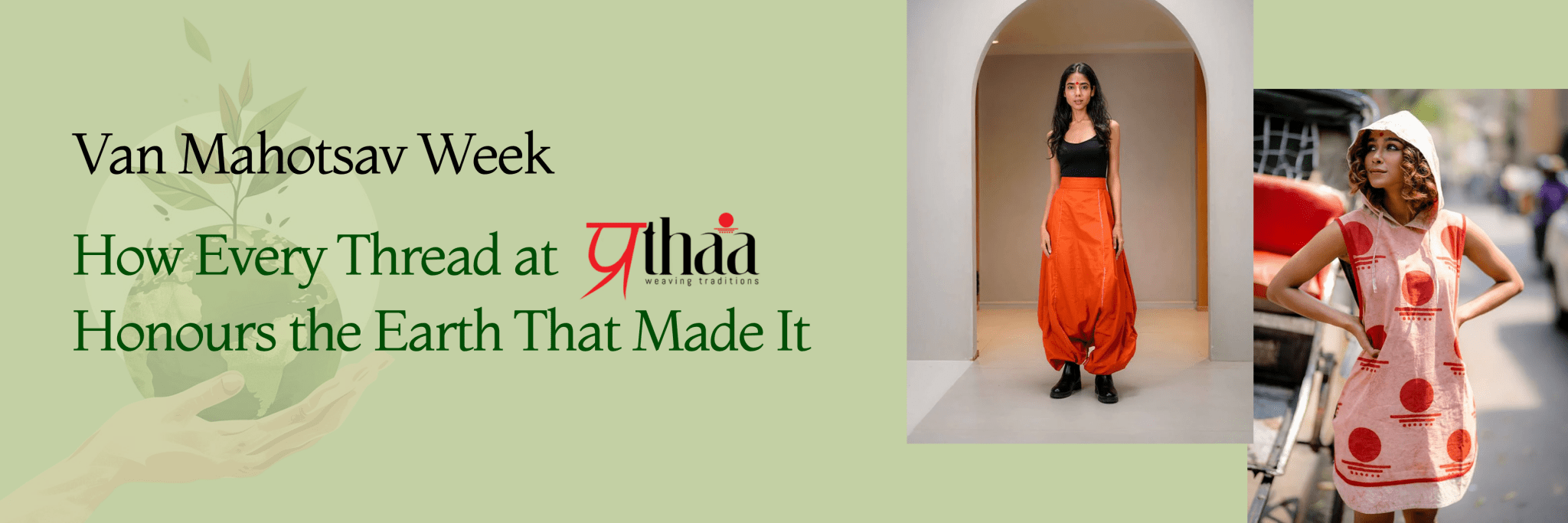
Van Mahotsav Week: How Every Thread at Prathaa Honours the Earth That Made It
Every July, India pauses to plant a tree. At Prathaa, we believe the most beautiful way to honour that spirit is to make sure the clothes on your back never cost the earth a single one.

The Bawra sleeveless summer dress — hand-block Batik on pure cotton, woven to breathe with you.
A Festival Born From a Simple, Radical Idea: Plant Life Back
In the first week of July, schools, offices, forest departments and ordinary families across the country step outside with saplings in hand. This is Van Mahotsav — the "Festival of Forests" — a week-long tree-planting movement that began in 1950, championed by India's then Union Minister for Agriculture, K. M. Munshi. Its idea was disarmingly simple: if we are going to keep taking from the land, the very least we can do is give something green back.
More than seventy years later, that idea feels less like a ceremony and more like an instruction. India loses tree cover every year to construction, industry and, yes, the things we wear. Van Mahotsav is the annual reminder that ecology is not a backdrop to our lives — it is our life. The air we breathe, the cotton in our wardrobes, the water that feeds the indigo vat: all of it begins with a living landscape.
For a fashion label, that reminder lands close to home. Because the uncomfortable truth is that clothing is one of the most resource-hungry, pollution-heavy industries on the planet. So when we mark Van Mahotsav, we don't just plant a sapling for the photograph. We ask a harder question: does the way we make clothes deserve a place in a week devoted to protecting nature? For Prathaa, the answer has to be yes — and it has to be true every single day, not just in July.
"Our purpose is to tread lightly and leave a minimal carbon footprint."
The Hidden Cost of Fast Fashion — and Why It Matters This Week
To understand why Van Mahotsav and conscious fashion belong in the same conversation, it helps to look at what conventional clothing actually demands of the earth.
-
Synthetic fabrics that never leave. Polyester and other synthetics are made from fossil fuels and shed microplastics into rivers and oceans with every wash — pollution that outlives the garment by centuries.
-
Toxic dyeing. Industrial dye houses are among the largest polluters of fresh water, releasing chemical-laden run-off straight into the waterways that nearby forests and farms depend on.
-
Mountains of waste. Trend-chasing "wear it twice" fashion creates staggering volumes of textile landfill, much of it non-biodegradable.
-
Energy-hungry machines. Power looms and mass production run on grid electricity at enormous scale, driving up the carbon cost of every piece.
Set that against the gentle arithmetic of Van Mahotsav — one sapling, one act of repair — and the contrast is stark. Planting a tree while wearing fashion that quietly degrades the soil, water and air around it is like bailing water from a boat with a hole still in the hull. Real respect for the earth means looking at the whole system, not just the symbolic gesture.

Rust handloom cotton harem pants — one weaver, one loom, zero synthetic fibre.
How Prathaa Treads Lightly: Sustainability Woven Into the Process
Prathaa — Weaving Traditions — was founded in 2016 with a mission that reads almost like a Van Mahotsav pledge in cloth: to revive India's forgotten handloom weaves and art forms while leaving the lightest possible mark on the planet. That mission isn't a marketing line bolted on after the fact. It shapes every decision, from the fibre we choose to the hands that finish the hem.
1. 100% Natural, Breathable Fabric
Every piece of Prathaa clothing is made in natural cotton and handloom fabric — never synthetics. Natural fibre is breathable, gentle on skin, and, crucially, it returns to the earth at the end of its life instead of lingering as microplastic. When a garment is grown rather than extracted from petroleum, sustainability begins at the very first thread. Explore the philosophy behind our cloth on our Fabric page.
2. The Handloom Difference — Power Without the Power Grid
A handloom needs no electricity. It is powered by human skill, rhythm and patience. By choosing handloom over power looms, Prathaa sidesteps one of the biggest carbon costs in textile production entirely. Each weave we work with — Jamdani, Khesh, Ikat, Kala Cotton, Ajrakh, Kalamkari, Kotpad — carries centuries of low-impact craft within it. Khesh, for instance, is a beautiful tradition of weaving new cloth from strips of upcycled fabric: sustainability that Bengal's weavers practised long before the word became fashionable.


Left: handwoven Jamdani. Right: Khesh — new cloth born from upcycled fabric strips.
3. Slow and Conscious by Design
"Slow and conscious" is one of the pillars we live by. A Prathaa design isn't rushed out to chase a trend; each piece, as we like to say, undergoes an elaborate birthing process with a story to tell. We make in mindful quantities, prioritising quality and longevity over volume. A garment you keep and love for years is, in the end, the most sustainable garment of all — it never becomes landfill.
4. Honest Work, Fair Play, Living Landscapes
Sustainability isn't only about the earth — it's about the people rooted in it. Prathaa was conceived as a creative platform to provide sustainable livelihoods to a family of weavers and artisans, the talent behind India's heritage crafts. We believe in a sense of fair play with weavers, customers and associates alike, because the well-being of the artisan and the well-being of the ecosystem are the same story told from two ends of the loom. When rural craft communities can earn with dignity, they have every reason to protect the land, the cotton fields and the natural dye plants their work depends on.
5. Natural Dyes and Minimal Footprint
From indigo to the earthy palettes of Dabu and Batik hand-block printing, our colour stories lean on traditional, low-impact techniques rather than the chemical-heavy industrial dyeing that poisons waterways. Tread lightly, leave little behind — that is the founder's stated purpose, and it runs all the way down to the colour of the cloth.
"There is now a consciousness to create wealth for grassroots artists, karigars, weavers and artisans, making a positive difference in their lives. Our purpose is to tread lightly and leave a minimal carbon footprint."
— Sukanya Bhattacharya, Founder, Prathaa
Your Wardrobe Is a Vote for the Forest
Here is the quiet, hopeful idea at the heart of Van Mahotsav week: small, repeated acts add up to landscapes. One sapling becomes a grove. One mindful choice becomes a habit. And the clothes you choose are one of the most frequent choices you make — you get dressed every single morning.
Every time you choose handloom over fast fashion, you are voting for cleaner rivers, for soil that isn't drenched in pesticide, for a weaver's child who gets to grow up in a craft tradition instead of watching it die. You are choosing a garment that will gracefully return back to the Earth rather than haunt a landfill for two hundred years. In that sense, buying consciously is its own kind of tree-planting: an investment in a living, breathing future.

The white linen-cotton Bindi saree — six yards of natural, breathable, earth-friendly grace.
Mark Van Mahotsav the Prathaa Way
This July, plant your tree — please do. But let the spirit of the week travel home with you and into your wardrobe. A few gentle ways to begin:
-
Choose natural fibre. Make your next purchase one that can return to the earth — explore our handloom cotton collection.
-
Buy less, love longer. Pick versatile, reversible and seasonless pieces like our handloom jackets that you'll reach for again and again.
-
Know your weave. Discover the low-impact traditions of Jamdani and Khesh.
-
Start them young. Introduce the next generation to a conscious lifestyle with our sustainable kidswear.
Wear the Festival of Forests, All Year Round
Every Prathaa piece is sustainably and ethically made in 100% natural cotton and handloom — breathable, biodegradable, and woven by hands that care for the earth as much as you do.
Tags: Van Mahotsav, sustainable fashion India, handloom clothing, slow fashion, eco-friendly clothing, ethical fashion, natural fabrics, conscious living, Prathaa
Written by Prathaa Weaving Traditions















Leave a comment
This site is protected by hCaptcha and the hCaptcha Privacy Policy and Terms of Service apply.