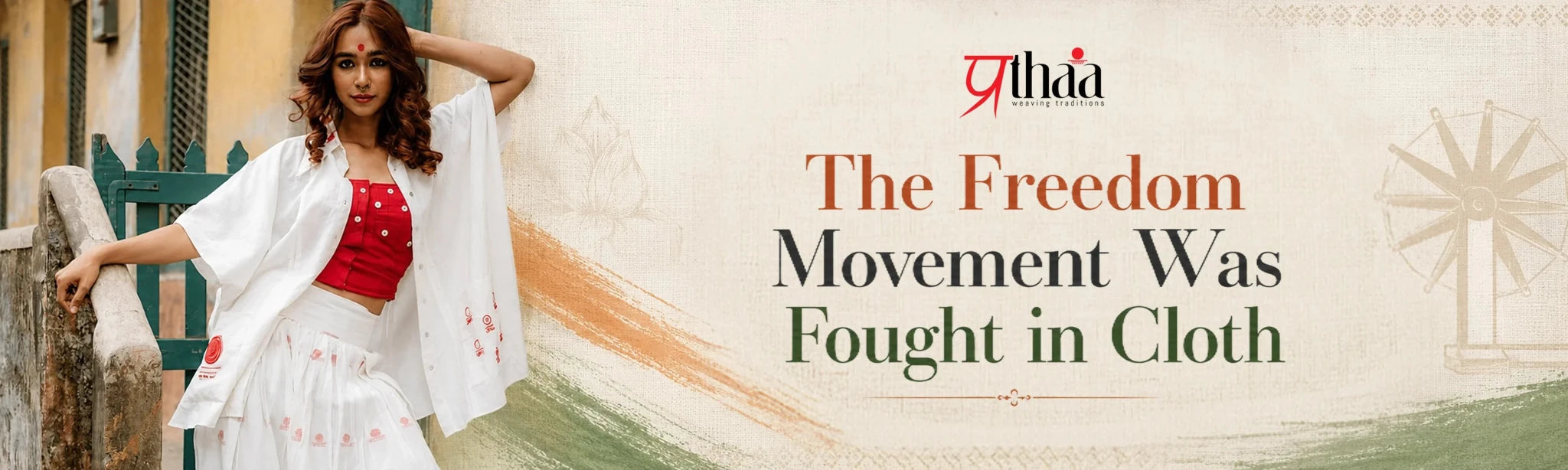
The Freedom Movement Was Fought in Cloth
From the boycott of foreign cloth in 1905 to the spinning wheel of the 1920s, hand-made fabric was a strategy — a way to starve an empire of its profits, one length of cloth at a time.
By Team Prathaa · 27 July 2026 · 5 min read · Filed under History, Handloom
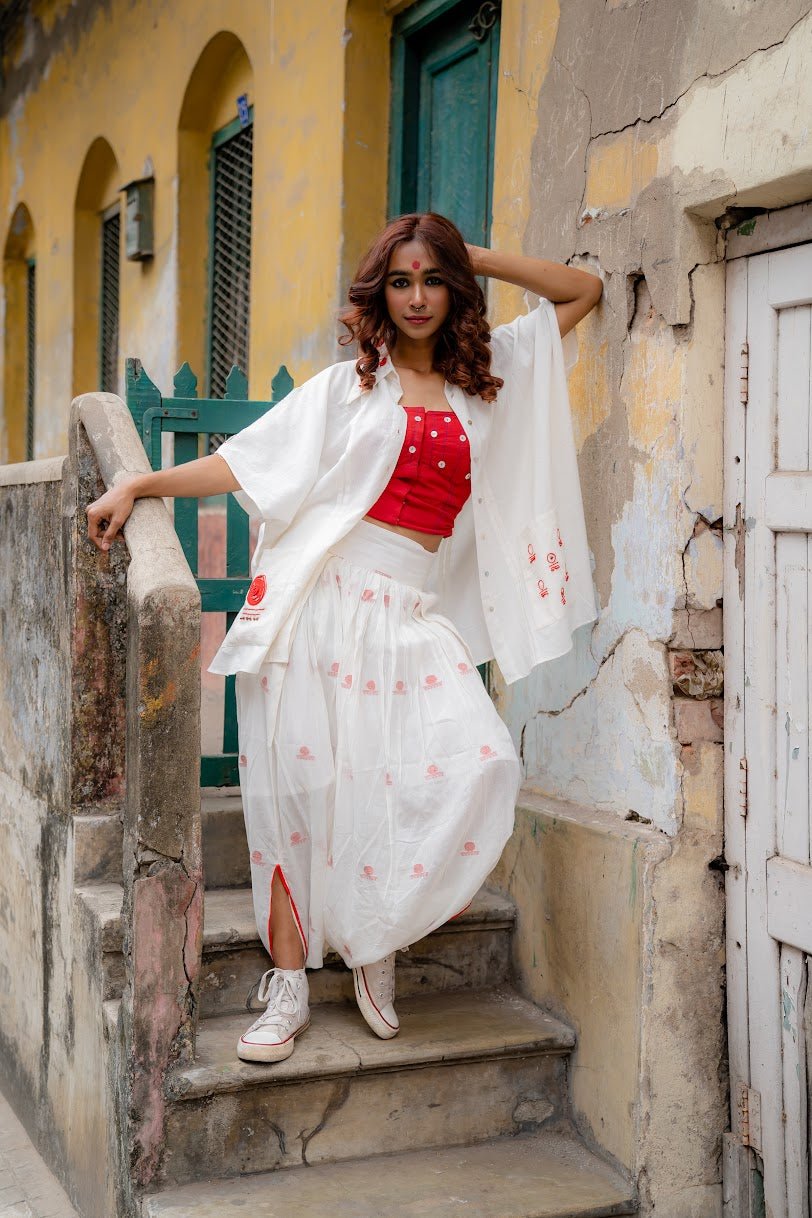
Hand-woven cotton on a manual loom — a small continuation of an old idea about who makes our clothes, and why it matters.
The short answer
India's freedom struggle wasn't only fought with speeches and marches. It was fought with cloth — across two phases. First the Swadeshi boycott of 1905, which urged Indians to reject foreign fabric; then, in the 1920s, the spinning wheel, which turned making your own cloth into a mass act anyone could join. Both hit the colonial economy where it hurt.
We tend to remember independence in the language of great events — marches, arrests, midnight speeches. But one of the movement's sharpest weapons wasn't dramatic at all. It was a length of cloth, and later a spinning wheel sitting quietly in a courtyard, turning cotton into thread.
How fabric became political
For much of the colonial period, India's own raw cotton was shipped abroad, spun and woven in the mills of Lancashire and Manchester, and sold back to Indians as finished fabric1. India, which had once made a quarter of the world's textiles, was reduced over roughly a century to an exporter of raw material and a captive market for British cloth2. The economics were humiliating, and the movement's leaders understood exactly how to turn that humiliation into leverage.
The answer was disarmingly simple: make your own cloth, and refuse to buy theirs.
Phase one: the boycott of 1905
The first great push came with the Swadeshi movement, triggered by the British decision to partition Bengal. On 7 August 1905, a formal boycott of foreign goods was declared at Calcutta's Town Hall3. Imported cloth was the prime target. The strategy had two halves: boycott, the destructive side, aimed at British trade; and swadeshi proper, the constructive side, which revived local hand-weaving and set up indigenous cloth cooperatives3. Public bonfires of foreign fabric became the era's most striking image — mountains of imported cloth set alight in town squares. Every metre burned was a metre no longer enriching a distant mill.
Phase two: the spinning wheel of the 1920s
The idea reached its widest form under Mahatma Gandhi in the 1920s, when the charkha — the spinning wheel — became the movement's central symbol4. In 1921 came a renewed call to boycott and burn foreign cloth on a mass scale5. What made this phase so effective was that anyone could take part. You didn't need to be an orator or risk arrest at a rally — you needed thread, a wheel and an hour a day. A grandmother in a village and a lawyer in a city could join the same act of defiance from their own homes.
A length of hand-made cotton became a vote — cast not at a ballot box, but at a loom.
Why cloth, of all things?
Because cloth touched everyone. Food, shelter and clothing are the things no household can avoid, and fabric was the one an empire had most thoroughly monopolised. Reclaiming it was both practical and symbolic at once: it created local livelihoods, kept money in Indian hands, and gave a scattered population a single, visible way to show they belonged to the same cause.
It also carried a moral argument. Making your own cloth meant valuing the labour of your own people over the convenience of imports. It dignified the weaver and the spinner — workers a colonial economy had treated as raw material rather than craftspeople.
The thread that still runs
India won its freedom in 1947, but the argument underneath the cloth never really expired. The question of whether we value fabric made by Indian hands — or default to whatever is cheapest and most disposable — is still a live one, just fought in shopping carts now instead of town squares.
That's the quiet reason handloom still matters. Every piece woven on a manual loom by a skilled artisan is a small continuation of an old idea: that how cloth is made, and who makes it, is never a trivial thing. The freedom movement understood that better than anyone. It's worth remembering, especially on August 15.
Sources
- Imperialism and Deindustrialization in India — OER Project
- Broadberry & Gupta, "Cotton Textiles and the Great Divergence" — LSE Economic History
- Swadeshi Movement — Encyclopædia Britannica
- Flag of India (charkha symbolism) — Encyclopædia Britannica
- From Looms to Gloom: Colonial Policy and Indian Artisans — Anaadi
Keep exploring: The Independence Day Edit · Handloom Sarees · Handloom Dresses · Meet the Founder
Written by Prathaa Weaving Traditions
















Leave a comment
This site is protected by hCaptcha and the hCaptcha Privacy Policy and Terms of Service apply.